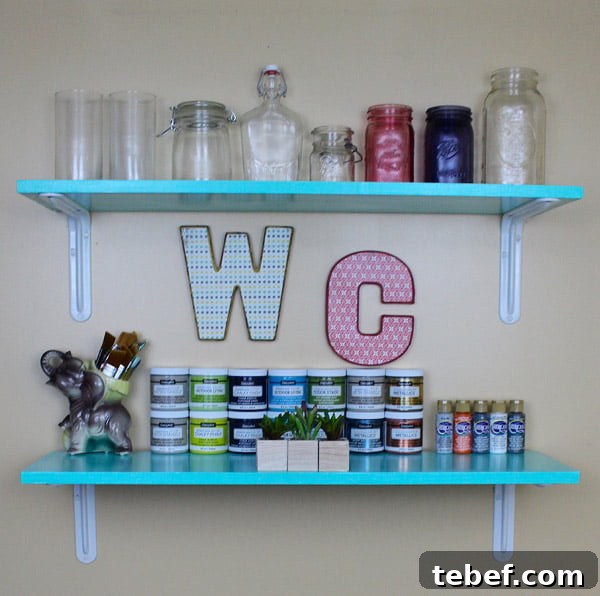
Over the long weekend I finally spent time in my craft room and the first project I tackled was building simple storage shelves. While picking up supplies for a kitchen renovation at Home Depot, I realized I needed better storage to organize craft supplies. I wandered the storage aisle considering options. Many ready-made laminate shelves didn’t meet my needs, and for the price I realized I could cut and paint my own shelves to better match the space. So I grabbed brackets and headed to the lumber department.
In lumber I compared pine and common board and chose a 1×12, 6-foot common board. I had about 4.75 feet of available wall space, so I had the staff cut the board into two 3-foot pieces. Most stores will cut lumber for you, which is handy if you lack tools or want to save time. Since I had cabinets drying on my workbench, I asked them to make the cuts to fit the car and to skip an extra step at home.
What you’ll need
- 12-inch shelf brackets
- 1 x 12, 6 ft common board
- Stain blocker
- High-gloss paint (I used a durable gloss finish)
- 1 5/8-inch drywall screws
- 1-inch drywall screws
- Painter’s tape
- Measuring tape
- Level
Because I used raw wood, I treated the boards with a stain blocker to prevent grain and knots from showing through the paint. I debated staining the wood, but the finished basement already has several wood tones, so I opted for an accent color I’ve been using—teal. I wanted a high-gloss, durable surface to hold paints, jars, and vases, so I chose a tough gloss enamel in the color Aqua Waters.
Two coats on each side and the two shelves were ready to hang.
Hanging shelves is often the most challenging step. Gather your measuring tape, painter’s tape, and level. First, locate your studs. In my finished basement I could lift ceiling tiles to see the studs; if that’s not an option, use a stud finder. Mark stud locations with painter’s tape. Measure down to your desired shelf height and mark that line with tape as well.
Here’s a trick I learned from my dad: before driving screws into the wall, tap a small trimming nail through the bracket hole to check that you’ve hit the stud. If you missed, the nail hole is tiny and easy to fill compared to a misplaced screw.
Screw the brackets into place using the 1 5/8-inch drywall screws. The brackets I used came with small covers to conceal the screw heads, so I didn’t worry about matching screw color. After inserting the first screw in each bracket, use a level to align the bracket before adding the remaining screws—this ensures the bracket sits plumb and your shelf will be level. Repeat on the other side.
Attach the board to the brackets using the 1-inch screws. If you prefer, drill pilot holes first to avoid splitting the wood. Drive screws just deep enough so they don’t protrude through the shelf or split the board. That’s it—you have a finished shelf. Repeat the process to install the second shelf.
I love how the shelves turned out. I even mounted some fun metal initials I picked up on clearance—people have already asked what “WC” stands for; of course it’s “Weekend Craft.”
My craft room is still a work in progress—more accurately, it’s currently a disaster—but I’ll share updates in the coming months once I finish the kitchen renovation. For now, these shelves have made a big difference in organizing paints, jars, and tools.
I’ll leave you with a favorite detail: a vintage Dumbo vase I use as a brush holder. I found it at a flea market a few years ago. It holds my detail brushes perfectly and now sits proudly on display.